Union Budget a ‘Reform Express’ Driving Railway-Led Viksit Bharat: Ashwini Vaishnaw
Exclusive to NewsStation, the Railway Minister says record ₹2.78 lakh crore allocation will transform safety, high-speed connectivity, freight corridors and rail manufacturing, accelerating economic growth and public confidence nationwide.

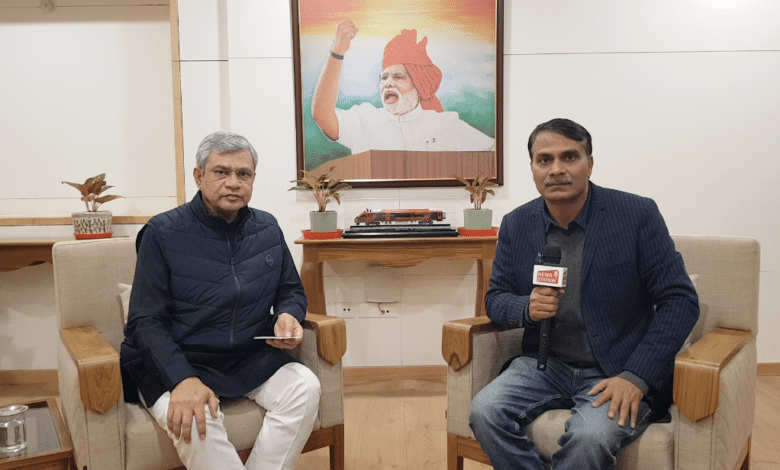
Calling the Union Budget a true “Reform Express,” Union Minister for Railways Ashwini Vaishnaw said the government has put a decisive stamp on railway-led transformation as part of the vision of Viksit Bharat. In an exclusive interview with Siddharatha, Editor, NewsStation, the Railway Minister outlined how record budgetary support will reshape rail infrastructure, safety, connectivity, and economic growth across India.
The Minister said the Union Budget has provided an unprecedented ₹2.78 lakh crore in budgetary support for Indian Railways. This, he noted, will directly benefit the country’s nearly 150 crore citizens and over 720 crore rail passengers annually. Of this, around ₹1.2 lakh crore has been earmarked exclusively for safety-related works. He highlighted that sustained efforts over the last decade have led to nearly 95% improvement in railway safety, with strong focus on track, wagon, locomotive and coach maintenance, installation of the Kavach safety system, digital stations, and upgradation of overhead electrification systems.
Vaishnaw said the transformation of Indian Railways under Prime Minister Narendra Modi has created renewed public confidence. Today, more than 160 Vande Bharat trains are operational, along with Namo Bharat services and over 50 Amrit Bharat trains, reflecting a shift towards modern, high-speed and passenger-centric rail travel.
Responding to questions on regional balance, the Railway Minister dismissed the North–South divide, stressing that the government firmly believes in Sabka Saath, Sabka Vikas. Of the seven newly announced high-speed rail corridors, three major corridors are in South India—Chennai–Bengaluru, Bengaluru–Hyderabad, and Chennai–Hyderabad—forming what he described as a Southern High-Speed Triangle. This network will drastically reduce travel times and boost tourism, healthcare access, and regional economies. For instance, Chennai–Bengaluru travel will take just 1 hour 13 minutes, while Bengaluru–Hyderabad will be around 2 hours.
In western India, the Pune–Mumbai high-speed corridor will cut travel time to just 48 minutes, effectively merging the two cities into a single economic zone. Combined with faster connectivity to Hyderabad, this will create a powerful West–South economic corridor. In the north, the Delhi–Varanasi high-speed corridor will reduce travel time to 3 hours 50 minutes, while Varanasi–Siliguri will take under 3 hours, creating a major economic belt across North and Eastern India.
On freight movement, Vaishnaw pointed to the success of the Eastern and Western Dedicated Freight Corridors, where around 400 freight trains run daily. Building on this, the Budget has announced a new 2,052-km freight corridor from Dankuni in West Bengal to Surat in Gujarat, passing through Odisha, Chhattisgarh, Madhya Pradesh and Maharashtra. This corridor will seamlessly connect with western ports, significantly boosting industrial activity and port-led development.
Addressing concerns on execution and capacity, the Railway Minister said India has emerged as a global leader in railway manufacturing. The country now produces about 16,600 locomotives and nearly 7,000 coaches annually, surpassing production levels in the US and Europe. New factories are stabilising, including Latur, while production at Kazipet is set to begin soon.
Concluding the interview, Ashwini Vaishnaw said passenger safety, affordability and better facilities remain the government’s top priorities, with continued subsidy support for passenger services.
“Railways are transforming—and with this transformation, India’s journey towards a developed nation is accelerating,” he said.