Industry Leaders Hail PM Modi’s AI Vision as Blueprint for Viksit Bharat@2047 at IISF 2025
India International Science Festival 2025 Spotlights India’s AI–AGI Ambitions; Experts Say Nation Poised for Global Leadership by 2035

The India International Science Festival (IISF) 2025, which commenced on December 6, has quickly cemented its position as one of the year’s most influential platforms for scientific exchange, youth engagement, and national innovation goals. As the country advances toward the vision of Viksit Bharat@2047, the festival’s third day delivered a powerful and thought-provoking session titled “AI & AGI: The Future of Intelligence.”
Bringing together prominent figures from academia, global technology companies, and India’s deep-tech startup ecosystem, the discussion shed light on how the transition from Artificial Intelligence (AI) to Artificial General Intelligence (AGI) will fundamentally reshape science, society, and India’s technological future.
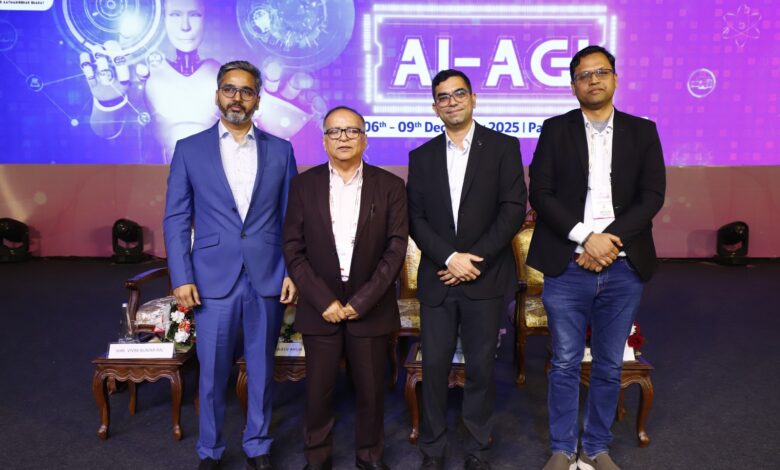
The distinguished speakers included Prof. Rajeev Ahuja, Director of IIT Ropar; Gopal Krishna Bhatt, Director – Data Center Customer Engineering, Intel; Vivek Kumar Rai, Head – Strategic Business, HPC & AI, NVIDIA; and Pratyush Kumar, Co-founder, Sarvam AI. Their insights highlighted the technological foundations India is building today to become a global AI powerhouse in the coming decade.
IndiaAI Mission Anchored to PM’s Vision of a Technologically Self-Reliant Bharat
Addressing a hall full of school students, Prof. Rajeev Ahuja emphasized that India is strategically positioning itself to emerge as a global leader in AI by 2035. This ambition is not merely aspirational—Ahuja explained that the nation’s youth-driven talent pool, data-rich ecosystem, and scientific curiosity form the perfect triad needed to excel in AI, machine learning, and future AGI systems.
He elaborated on the Prime Minister’s IndiaAI Mission, which aims to:
- Train one crore young Indians in AI and emerging technologies
- Build national compute capacity and AI infrastructure
- Develop indigenous, ethically aligned AI models
- Strengthen innovation across priority sectors including digital health, smart cities, and agriculture
Ahuja highlighted IIT Ropar’s role as one of the three national Sectoral AI Centres of Excellence, with a specific mandate in agriculture. These centers, established by the Ministry of Education, are working to deploy AI solutions across real-world challenges—from crop productivity to climate resilience.
He added that robust AI development cannot be separated from semiconductor capability. Drawing attention to India’s push for domestic chip manufacturing, he said, “Our strength in human resources and data gives India a unique edge. Semiconductors will be the backbone of Viksit Bharat. We must become global leaders here.”
Industry Leaders Spotlight India’s Rapid Progress in High-Performance Computing and Semiconductor Ecosystems
Offering an industry perspective, Gopal Krishna Bhatt of Intel outlined how India is witnessing a rapid evolution in server design, chip engineering, and high-performance computing (HPC) systems. He cited Intel’s partnership with CDAC on the indigenous ‘Rudra’ server platform as a landmark project showcasing India’s transition from dependency on imported server architectures to homegrown solutions.
Bhatt revealed that dozens of India-based data center and server hardware designs are currently in the pipeline, reflecting the accelerating momentum generated by the Government’s Digital India and semiconductor initiatives. He encouraged young students to nurture curiosity—calling it the essential spark behind every breakthrough innovation.
NVIDIA Highlights How AI Is Powering India’s Scientific and National Missions
Vivek Kumar Rai from NVIDIA elaborated on how AI is already revolutionizing scientific discovery across multiple domains. He described cutting-edge applications where AI is dramatically reducing research timelines:
- Drug and vaccine development
- Climate modeling and weather prediction
- Material science simulations
- Advanced automotive engineering
Rai highlighted the role of GPU-based computing in major national missions, including supercomputing initiatives and digital research infrastructures. NVIDIA, he noted, continues to collaborate with Indian ministries, academic institutions, and research centers to accelerate innovation.
Importantly, he emphasized AI’s societal role: “AI is breaking linguistic and digital barriers. In a country as diverse as India, technology must democratize opportunity. That is the vision the Prime Minister has articulated—and we see it unfolding.”
Sarvam AI Underscores the Importance of Indian-Language AI and Sovereign LLMs
Sarvam AI’s Co-founder Pratyush Kumar placed the spotlight on India’s multilingual identity and the urgent need for AI systems that reflect this diversity. He showcased progress under the IndiaAI Mission, including India’s first sovereign foundational Large Language Model (LLM) for Indian languages—selected by the Government this year.
Kumar connected the festival’s theme “Vigyan Se Samriddhi” (Prosperity through Science) with AI’s crucial role in supporting scientific research, policy decisions, and inclusive development. He noted that AI is already helping solve problems in agriculture, climate action, public service delivery, and economics.
He stressed that AI’s future is deeply integrated with every profession—from law and healthcare to education and engineering. “For equitable progress, India needs India-centric datasets, models, and linguistic technologies. Inclusive AI is central to the Prime Minister’s vision of Viksit Bharat,” he added.
Panel Discussion: AI & AGI—Charting India’s Next Technological Leap
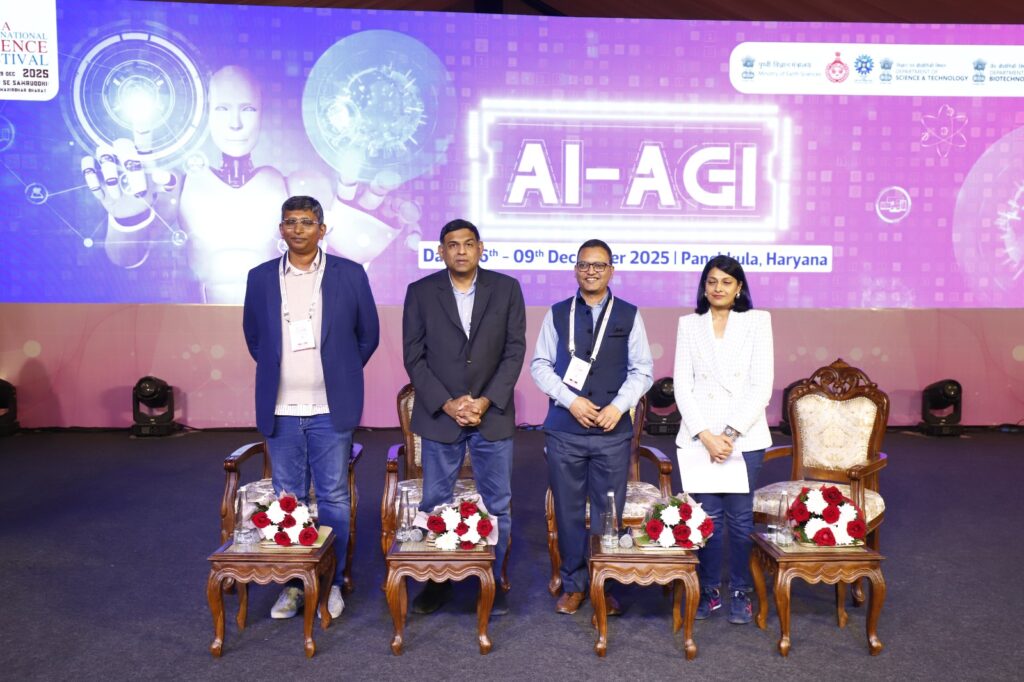
Following the keynote addresses, a high-energy panel discussion brought together Xavier Kurian (Neysa), Ganesh Gopalan (Gnani.ai), and Dr. Manish Modani (NVIDIA). The panel explored how India’s deep-tech ecosystem is preparing for the shift from narrow AI to advanced, general-purpose AGI systems.
AI Adoption No Longer Optional for Indian Industries
Neysa’s Xavier Kurian shared that enterprise AI adoption in India has moved from experimentation to necessity. Key sectors—BFSI, manufacturing, retail, healthcare, and government services—are deploying AI at scale for automation, analytics, and citizen service delivery.
He emphasized the government’s proactive role, noting that policies under the IndiaAI Mission have created a fertile environment for innovation.
India’s AI Models Now Competing Globally
Gnani.ai CEO Ganesh Gopalan highlighted how sovereign datasets and foundational models supported by the Government are enabling Indian startups to build globally competitive AI products. He revealed that various government departments are using AI extensively, with multilingual voice automation now processing billions of tokens daily.
“AI is becoming a national differentiator. Under PM Modi’s leadership, India has clarity, direction, and scale,” he said.
AGI Will Find Its Earliest Footprint in India, Says NVIDIA Scientist
NVIDIA’s Dr. Manish Modani said India’s expanding HPC and GPU infrastructure is multiplying research outcomes in climate science, energy, medicine, and language technologies. India’s unique combination of data volume, linguistic diversity, and scientific talent positions it as a strong contender in the global race toward AGI.
India on a Decisive Path Toward AI Leadership
Across all discussions, a consistent theme emerged: India’s demographic edge, innovation-driven youth, and strong government support are collectively positioning the nation to lead the world in AI and AGI.
Speakers urged students to embrace AI tools, study deep-tech fields, and contribute to India’s long-term vision of becoming a knowledge-driven, innovation-led Viksit Bharat by 2047.
The IISF 2025 continues to serve as a beacon of scientific aspiration, inspiring the next generation to contribute to India’s technological rise on the global stage.