India’s Railway Revolution Takes Center Stage at IREE 2025: Industry Leaders Highlight Opportunities and Challenges

As India accelerates its ambitious railway modernization drive, the spotlight turns to the 16th International Railway Equipment Exhibition (IREE) 2025, Asia’s premier showcase for railway technology and innovation. Scheduled for October 15–17 at Bharat Mandapam in New Delhi, the event is organized by the Confederation of Indian Industry (CII) in collaboration with Indian Railways. It will bring together leading global and Indian companies to unveil cutting-edge solutions in rolling stock, signaling, and infrastructure.
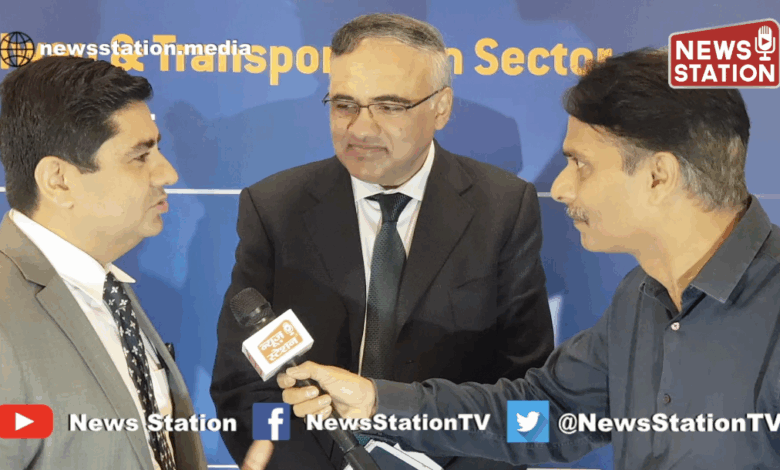
The exhibition comes at a pivotal moment for Indian Railways, which is investing heavily in expansion and upgrades amid a booming budget. Speaking exclusively to News Station Delhi ahead of the event, two key industry participants – Puneet Kaura, Managing Director of Samtel Avionics Ltd, and Narayan Sethuraman, Managing Director of Sanmar Matrix Metals Ltd – discussed the vast opportunities, persistent challenges, and the path forward for the sector.
A Budget Bonanza Fueling Growth
Kaura emphasized the scale of investment, noting that Indian Railways’ budget stands at ₹2.5 lakh crore this fiscal year, growing at a steady 6% annually. “Two to three years ago, it was 15-20% lower, and in the next five to six years, it’s projected to reach ₹3.5 lakh crore,” he said. This surge, he added, represents a “massive opportunity” not just domestically but globally, where the railway market is valued at $350 billion.
Indian products, particularly in rolling stock, have gained international credibility for their quality. “Global players like Alstom and Siemens are now planning major buys from India,” Kaura highlighted, attributing this to proven innovation and reliability.
Vande Bharat Hype vs. Ground Realities
The conversation turned to the flagship Vande Bharat trains, often touted by the government as a symbol of progress. However, reporter Siddhartha pointed out a common public critique: “It’s being called the ‘train for the rich’ – what about ordinary people? And there’s a contradiction: we’re building modern rolling stock on one hand, while old diesel engines continue production on the other.”
Sethuraman framed this as part of a broader modernization program. Citing the shift from manual to automatic couplers – which once required manual joining of each coach – he said, “Today’s products are transforming operations.” On signaling, he praised the indigenous Kavach 4.0 anti-collision system, now fully optimized and supplied by Indian firms. “It’s a prime example of innovation in the last few years, backed strongly by the government,” Sethuraman added. He noted rapid advancements in electronics and rolling stock across public and private sectors, especially in safety enhancements.
Safety, Jobs, and the AI Shadow
Safety remains a flashpoint, with railway unions protesting understaffing and warning that automation could erode jobs. “They’re saying there’s no recruitment, and with AI coming in, employment opportunities will vanish,” Siddharatha observed.
Kaura acknowledged the global debate but remained optimistic. “AI won’t eliminate all jobs; it creates new ones. Humans are still needed to refine and innovate AI,” he explained. While work methods will evolve – “You might not do the same tasks in five years” – opportunities will persist, provided workers reskill. “Scaling is crucial for India’s growth, and jobs will be there, just in different forms.”
Five Key Focus Areas for Indian Railways
When asked about priorities for the next phase of transformation, Sethuraman urged faster action on several fronts: deeper modernization, accelerated scale expansion (as Vande Bharat’s popularity – with 200 trains already – sparks demands in every constituency), upgraded signaling, and integration of emerging tech like IoT and AI.
Kaura and Sethuraman jointly added two pillars: innovation and skilling, which are interlinked. “Without skilling, innovation can’t thrive,” Sethuraman stressed. “These are essential not just for railways but for India to become a global leader. We’re on track to be the world’s third-largest economy – to stay ahead, we must climb innovation indices.” He also flagged the need for robust manufacturing scale and supply chains to match this growth.
Lessons from the Bullet Train Delay
The discussion closed with the Mumbai-Ahmedabad bullet train project, India’s first high-speed venture, which faced delays due to political hurdles and land acquisition issues, inflating costs. “It started with fanfare but got tangled in politics,” Siddharatha noted.
Kaura attributed setbacks to democratic processes: “Anticipating timelines for land – whether from farmers or other reasons – is tough, but it was resolved eventually.” As the pioneering effort, he viewed it as a learning curve. “Other countries faced issues too in their first bullet trains. If we halve the time for future projects, it’ll be a win.” With plans for high-speed corridors in multiple cities, he expressed hope that these lessons will streamline execution.
As IREE 2025 unfolds, it underscores Indian Railways’ evolving landscape, where government vision meets industry muscle. “Railways is driving change, but industry’s support is amplifying it,” Siddhartha concluded from the News Station.
For more on the event, visit the official IREE website or follow live updates from Bharat Mandapam.