India’s Rail Electrification Drive Nears Completion, Paving the Way for Net-Zero Emissions and Cleaner Mobility

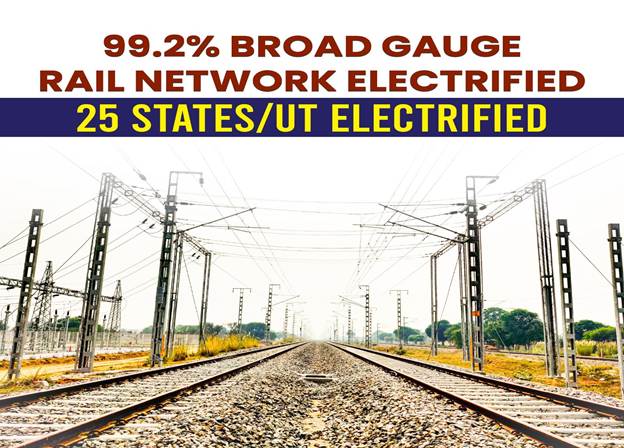
India is on the brink of completing one of the most ambitious railway electrification programmes in the world, with Indian Railways having electrified more than 99 per cent of its broad-gauge network. The remaining small stretches are expected to be completed soon, marking a historic milestone in the country’s journey towards cleaner, faster and more efficient passenger and freight mobility.
The scale and pace of India’s rail electrification in recent years have been unprecedented. Between 2019 and 2025, Indian Railways electrified over 33,000 route kilometres, achieving an average electrification rate of more than 15 route kilometres per day. The distance electrified during this six-year period alone is almost equivalent to the entire railway network of Germany, highlighting the magnitude of the effort and the seriousness with which India has pursued clean rail traction.
With 99.2 per cent of the broad-gauge network now electrified across 25 states and union territories, India has effectively transformed the backbone of its rail system. Broad-gauge routes carry the overwhelming majority of passenger and freight traffic in the country, making their electrification critical for both economic efficiency and environmental sustainability.
India’s achievement stands out even when compared with countries that have long-established and technologically advanced railway systems. Electrifying such a vast and heavily used network—one of the largest and busiest in the world—poses enormous technical, logistical and financial challenges. Despite this, Indian Railways has managed to push ahead with clear planning, sustained investment and coordinated execution across multiple zones and project units.
The transition from diesel to electric traction has already begun to deliver substantial benefits. Diesel consumption has declined sharply, reducing India’s dependence on fossil fuels and insulating railway operations from global fuel price volatility. Lower fuel costs have translated into significant savings in operating expenditure, improving the financial efficiency of the national transporter.
Electrification has also led to a marked reduction in carbon emissions and air pollution. Electric locomotives are cleaner at the point of use and, as India’s power generation mix increasingly incorporates renewable energy, the overall carbon footprint of rail transport continues to shrink. This aligns closely with Indian Railways’ stated objective of becoming a net-zero carbon emitter in the coming years.
Operational efficiency has improved as well. Electric trains offer better acceleration, higher hauling capacity and more consistent performance compared to diesel locomotives. These advantages enable faster passenger services, improved punctuality and greater line capacity—critical factors for a network that serves millions of passengers every day and carries a significant share of the country’s freight.
Globally, India’s progress sets a new benchmark. While several advanced economies continue to rely substantially on diesel traction due to high electrification costs, legacy infrastructure constraints or limited network expansion, India has demonstrated that large-scale electrification is achievable with sustained political commitment and administrative focus. The country’s experience is increasingly being viewed as a model for other nations seeking to decarbonise their rail systems.
As the final unelectrified stretches are completed, India is set to operate one of the world’s largest fully electrified railway networks. This transformation is expected to strengthen the resilience of rail operations, enhance energy security and support long-term economic growth.
For passengers, the benefits are tangible—cleaner journeys, reduced noise, smoother acceleration and more reliable services. For the nation, the near-completion of rail electrification represents a decisive step towards sustainable transport, reinforcing India’s leadership in green infrastructure development and bringing the vision of net-zero rail operations firmly within reach.