Punjab Records 4,459 Stubble-Burning Incidents; 1,310 Sites Physically Verified, CAQM Report Reveals
Tarn Taran Leads with 654 Farm-Fire Incidents, Followed by Ferozepur and Sangrur; ₹62.55 Lakh Environmental Compensation Imposed, ₹32.60 Lakh Recovered

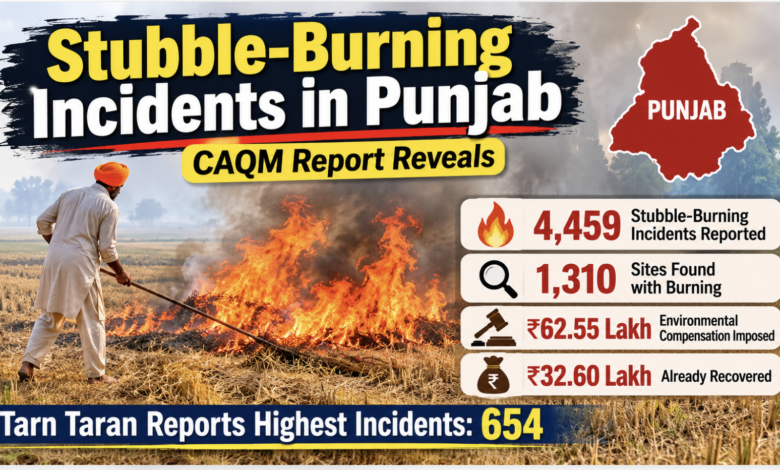
Punjab has reported 4,459 stubble-burning incidents during the ongoing paddy harvesting season, with physical inspections confirming crop residue burning at 1,310 locations, according to the latest monitoring and enforcement report of the Commission for Air Quality Management (CAQM).
The report, covering the period up to November 8, 2026, highlights the scale of enforcement measures undertaken across 23 districts of Punjab to curb stubble burning, which is a major contributor to seasonal air pollution in northern India, particularly in the National Capital Region (NCR).
According to the district-wise data, authorities have physically inspected 2,998 locations out of the 4,459 reported fire incidents. Of these inspected sites, evidence of crop residue burning was found at 1,310 locations. The report also records 122 non-AFL fields where burning traces were identified by PPF or nodal officers.
Environmental compensation (EC) has been imposed in 1,228 cases involving verified stubble-burning incidents. The cumulative amount of compensation imposed stands at ₹62.55 lakh, of which ₹32.60 lakh has been recovered so far.
The report indicates that enforcement action has also extended to police cases, revenue records and administrative accountability, with 884 FIRs registered, 1,017 red entries recorded in farm land records and prosecution proceedings initiated against 18 supervisory officers.
Tarn Taran Reports Highest Number of Stubble-Burning Incidents
Tarn Taran district has recorded the highest number of stubble-burning incidents in Punjab, with 654 cases reported up to November 8. Physical inspections were conducted at 618 locations, with burning confirmed at 306 sites.
Ferozepur ranks second with 592 reported incidents. Of these, 380 locations were inspected and crop residue burning was physically verified at 247 sites.
Sangrur reported 488 incidents, followed by Bathinda with 406 cases and Patiala with 288 cases.
The five districts together account for a substantial share of the total reported incidents across the state.
The district-wise figures also reveal significant differences between reported incidents and the number of locations where burning was physically confirmed.
District-wise Stubble-Burning Monitoring in Punjab
Data as of November 8, 2026
| District | Reported incidents | Sites inspected | Burning physically verified |
|---|---|---|---|
| Amritsar | 247 | 219 | 124 |
| Barnala | 230 | 106 | 61 |
| Bathinda | 406 | 239 | 29 |
| Fatehgarh Sahib | 63 | 49 | 10 |
| Faridkot | 170 | 115 | 22 |
| Fazilka | 122 | 64 | 25 |
| Ferozepur | 592 | 380 | 247 |
| Gurdaspur | 125 | 113 | 48 |
| Hoshiarpur | 28 | 24 | 4 |
| Jalandhar | 98 | 87 | 51 |
| Kapurthala | 139 | 134 | 48 |
| Ludhiana | 193 | 113 | 62 |
| Mansa | 149 | 87 | 11 |
| Moga | 188 | 104 | 41 |
| Muktsar | 113 | 56 | 10 |
| SBS Nagar | 16 | 11 | 4 |
| Pathankot | 1 | 1 | 0 |
| Patiala | 288 | 157 | 94 |
| Rupnagar | 6 | 4 | 1 |
| SAS Nagar | 19 | 17 | 5 |
| Sangrur | 488 | 223 | 70 |
| Tarn Taran | 654 | 618 | 306 |
| Malerkotla | 124 | 77 | 37 |
| Total | 4,459 | 2,998 | 1,310 |
₹62.55 Lakh Environmental Compensation Imposed
The CAQM report highlights financial penalties as an important component of the enforcement strategy against stubble burning.
Environmental compensation has been imposed in 1,228 cases across Punjab, with the total amount reaching ₹62.55 lakh. Of this, ₹32.60 lakh has been realised, while the remaining amount is yet to be recovered.
Tarn Taran has the highest district-level environmental compensation figures, with ₹15.55 lakh imposed and ₹14.95 lakh recovered.
Ferozepur follows with ₹12.35 lakh in compensation imposed, of which ₹4.20 lakh has been recovered. Patiala has recorded ₹3.45 lakh in imposed compensation, with ₹1.25 lakh realised.
Other districts, including Amritsar, Gurdaspur, Jalandhar and Kapurthala, have also reported enforcement through environmental compensation.
Environmental Compensation: Key Figures
| Particulars | Reported figures |
|---|---|
| Total cases with EC imposed | 1,228 |
| Total compensation imposed | ₹62.55 lakh |
| Compensation recovered | ₹32.60 lakh |
| Compensation yet to be recovered | ₹29.95 lakh |
884 FIRs Registered, 1,017 Red Entries Made in Land Records
Apart from financial penalties, authorities have initiated legal and administrative action against incidents of stubble burning.
According to the report, 884 FIRs have been registered under Section 223 of the Bharatiya Nyaya Sanhita (BNS).
Tarn Taran accounts for 306 FIRs, followed by Ferozepur with 98, Patiala with 77 and Sangrur with 70.
The authorities have also made 1,017 red entries in farm land records as part of the enforcement measures. Tarn Taran has recorded 306 such entries, followed by Ferozepur with 150, Amritsar with 93 and Sangrur with 70.
These entries form part of the administrative measures being used to identify and track agricultural land associated with stubble-burning incidents.
Prosecution Initiated Against 18 Supervisory Officers
The CAQM report also points to administrative accountability, with prosecution proceedings initiated against 18 supervisory officers under Section 14 of the CAQM Act.
Tarn Taran accounts for 13 of these cases, while Ferozepur accounts for five.
However, the report records zero charge sheets issued to nodal or supervisory officers and no suspension orders against such officers during the reporting period.
A total of 1,103 warning notices and show-cause notices have been issued to nodal and supervisory officers across the state. Amritsar accounts for 333 notices, followed by Patiala with 185 and Tarn Taran with 148.
The figures indicate that enforcement measures are being directed not only towards farmers but also towards officials responsible for monitoring and preventing crop residue burning.
Punjab Reports 91.40% Paddy Harvesting
The CAQM monitoring report also provides an overview of the paddy harvesting situation in Punjab.
The state has a total paddy area of approximately 32.87 lakh hectares, of which 91.40 per cent had been harvested by November 8, 2026.
The district-wise harvesting progress shows that several districts have crossed 95 per cent completion, while others are still in the process of completing harvesting operations.
With the harvesting season progressing towards completion, authorities continue to monitor fields and take action against incidents of crop residue burning.
Stubble Burning Remains a Major Challenge for Air Quality Management
Stubble burning in Punjab and neighbouring agricultural states has remained a major concern during the post-monsoon and winter months because smoke and particulate emissions can contribute to deteriorating air quality across northern India.
The CAQM’s latest figures provide an assessment of reported incidents, physical verification, environmental compensation, police action and administrative enforcement in Punjab.
With 4,459 reported incidents and 1,310 physically verified locations, the report underlines the continuing challenge of preventing agricultural residue burning despite monitoring and enforcement measures.
The recovery of environmental compensation, registration of FIRs and initiation of proceedings against supervisory officers form part of the broader strategy to strengthen compliance.
The coming days will remain important for monitoring the remaining harvesting operations and ensuring that crop residue is managed through alternatives to open-field burning.