
Trump, Tech Giants Sign ‘White House Accord on Super Intelligence’ for Frontier AI Safety

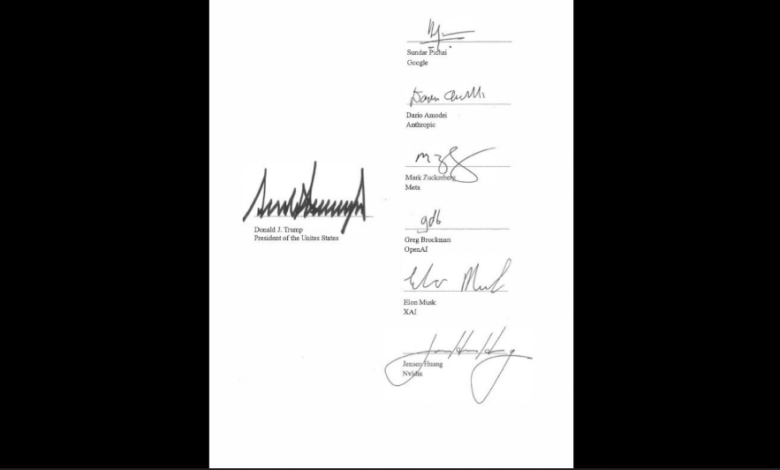
The White House has released the “White House Accord on Super Intelligence – Joint Commitment on Frontier Responsibilities,” outlining a voluntary framework for technology companies developing and deploying advanced artificial intelligence systems.
The document sets out a four-layer approach to AI safety and oversight, calling on companies working with frontier models to establish robust internal controls, dedicated oversight teams, independent external evaluations and board-level supervision.
The accord states that the objective is to build a positive future for the American people and the wider world by ensuring that companies developing advanced technologies take responsibility for their safe operation and work to maintain public and customer trust.
The White House document emphasizes that companies developing frontier models should have robust internal processes and controls to ensure that their technology behaves as intended and that potential problems are identified and addressed promptly.
According to the released accord, participating companies have committed to implementing four principal layers of controls and audits.
Four-Layer Safety Framework
The first layer involves robust internal controls within companies developing and deploying frontier models.
The accord calls for companies to monitor the capabilities and alignment of their models during both training and deployment. Particular attention is to be given to areas including cybersecurity, biosecurity and chemical threats.
The document also calls for safeguards designed to ensure that AI models do not hack into or access technical systems in unintended ways.
The first layer therefore places responsibility directly on companies to understand how their advanced models behave and to identify potentially problematic capabilities or actions during the development and deployment process.
The second layer requires companies to establish an internal team responsible for oversight.
According to the White House document, this team would ensure that the company’s controls, monitoring and detection mechanisms are functioning as intended. It would also be responsible for ensuring that issues identified through these processes are appropriately remediated.
The framework consequently separates the operation of AI systems from a dedicated internal function responsible for checking whether the associated safeguards are actually working.
The third layer introduces independent external assessment.
Companies participating in the accord are expected to partner with an independent external auditor or evaluator. The purpose is to conduct assessments of whether the controls, monitoring and detection mechanisms are operating as intended.
This provision adds an external layer of scrutiny to the companies’ own internal safety procedures. Rather than relying exclusively on internal assessments, the framework calls for outside evaluation of the systems designed to manage frontier AI risks.
The fourth layer places responsibility at the board level.
The accord calls on companies to designate an independent committee of their boards of directors to oversee the safety-control structure.
The committee would receive reports from teams responsible for operating the controls as well as from internal and external auditors and evaluators. It would also be responsible for ensuring that issues identified through those processes are addressed.
Together, these four layers establish a chain of oversight extending from technical controls inside an AI company to internal monitoring, independent external evaluation and corporate board supervision.
Companies Asked to Build Public Confidence
The White House accord says the measures are intended to give companies, their customers and the public greater confidence that the technology is operating as intended.
The document places particular emphasis on responsibility at the company level, stating that every company is responsible for developing its own technology safely and in a manner that builds trust with customers and the public.
The framework applies to companies that are training and deploying frontier models, reflecting the White House focus on increasingly advanced AI systems rather than AI applications in general.
The document does not prescribe a particular model architecture, technical system or single testing methodology. Instead, it establishes broad organizational responsibilities around monitoring, detection, auditing and oversight.
Regular Cooperation on Standards
The participating companies will also meet regularly under the accord to establish standards and best practices intended to improve the safety of their systems.
This provision creates a mechanism for companies to work collectively on safety practices as AI technology develops.
The document indicates that the companies’ responsibilities are not necessarily intended to remain limited to the voluntary framework.
It states that, over time, it may make sense to codify the measures into laws or regulations.
At the same time, the accord says that regardless of whether such requirements become legally mandatory, the participating companies are committed to implementing the controls and audits described in the document.
Signatures From Major Technology Leaders
The released document carries signatures associated with major companies involved in frontier AI and advanced computing.
The signature page identifies Sundar Pichai of Google, Dario Amodei of Anthropic, Mark Zuckerberg of Meta, Greg Brockman of OpenAI, Elon Musk of xAI and Jensen Huang of Nvidia.
The document also carries the signature of Donald J. Trump, President of the United States.
The accord is presented as a joint commitment concerning the responsibilities of companies developing advanced AI technology.
Its central emphasis is not on a particular AI product but on the systems and organizational structures companies should maintain around the development and deployment of frontier models.
Focus on Cybersecurity, Biosecurity and Chemical Risks
One of the notable features of the White House framework is its explicit reference to several categories of potential risk.
The internal-control requirements specifically mention cybersecurity, biosecurity and chemical threats.
The document also addresses the possibility of AI systems accessing technical systems in unintended ways. Companies are therefore expected to maintain controls designed to prevent their models from hacking or accessing systems outside their intended scope.
These provisions place model behavior and capability monitoring at the center of the framework.
The accord calls for companies to identify issues promptly and establish processes for remediation rather than waiting for problems to become public or cause wider consequences.
Internal and External Accountability
The structure described in the accord combines company-level responsibility with independent oversight.
At the first level, companies are expected to operate technical controls themselves. An internal team then monitors whether those controls are functioning properly.
An independent external evaluator provides another layer of assessment, while an independent board committee receives reports from the relevant teams and auditors.
The four-stage structure can therefore be summarized as:
| Layer | White House Accord Requirement |
|---|---|
| 1. Internal controls | Monitor model capabilities and alignment and address identified risks |
| 2. Internal oversight | Ensure controls, monitoring and detection systems operate as intended |
| 3. External evaluation | Independent auditors or evaluators assess the controls |
| 4. Board oversight | Independent board committee reviews reports and ensures issues are remediated |
The White House document presents these measures collectively as a way to strengthen confidence in the development and deployment of frontier technology.
Voluntary Commitment With Possible Future Regulation
The accord does not itself set out a new statutory regulatory system. Instead, it describes commitments that participating companies are agreeing to undertake.
The document nevertheless leaves open a future role for formal government regulation, stating that the measures could eventually be incorporated into laws or regulations.
For the participating companies, the stated commitment is to implement the controls and audits regardless of whether they become legally required.
The White House framework thus establishes a model in which company responsibility, internal monitoring, independent assessment and board oversight operate together.
A Framework for Frontier AI Responsibilities
The White House Accord on Super Intelligence represents a formal statement of responsibilities for companies developing and deploying frontier AI models.
Its central message is that advanced AI development should be accompanied by systems capable of monitoring model capabilities, identifying unintended behavior, detecting risks and ensuring that identified problems are corrected.
The document also establishes a mechanism for continuing cooperation among participating companies through regular meetings focused on common standards and best practices.
At its core, the accord calls for four levels of accountability: technical and internal controls, dedicated internal oversight, independent external evaluation and independent board supervision.
The White House document concludes that these measures are intended to support a safer future for the public while strengthening confidence that increasingly advanced AI technologies are operating as intended.
The framework also leaves open the possibility that these voluntary commitments could eventually form the basis for formal laws or regulations, making the accord a potential starting point for further development of AI safety standards.