First Steel Bridge for Mumbai–Ahmedabad Bullet Train Project Launched in Maharashtra

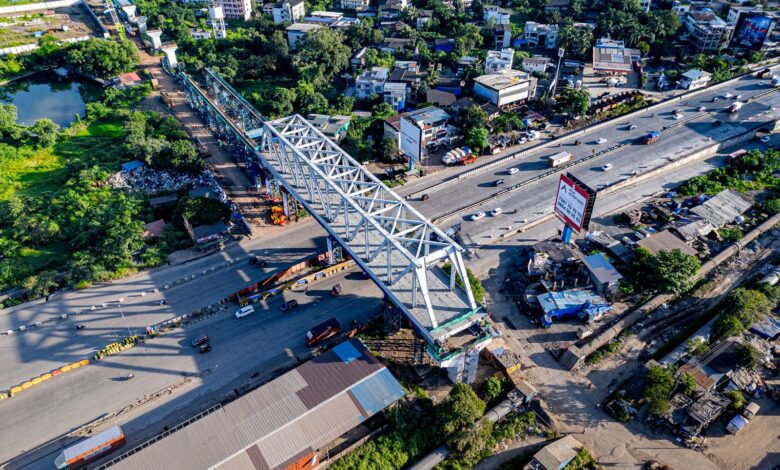
The first steel bridge completed for the Mumbai–Ahmedabad Bullet Train Project in Maharashtra has been successfully launched over National Highway-3 (Nashik Highway) at Dive-Anjur village in Bhiwandi, Thane district. The 100-metre-long bridge weighs approximately 1,405 metric tonnes and marks a significant milestone in the construction of India’s high-speed rail infrastructure.
The bridge is also being highlighted as an example of the growing capability of Indian industry to manufacture, transport and install complex steel structures for technologically advanced infrastructure projects.
One of the key features of the project is that the bridge was fabricated at a workshop in Tiruchirappalli (Trichy), Tamil Nadu, around 1,300 kilometres from the launch site in Maharashtra. After fabrication, the massive structure was transported to Maharashtra on trailers and assembled at the site before being installed over the highway.
The fabrication process involved precision cutting, drilling, welding and painting in accordance with the prescribed engineering designs, drawings and technical specifications. Each batch of steel used in the bridge underwent Ultrasonic Testing (UT) to check the material quality. Welders and supervisors involved in the fabrication were certified by International Welding Experts, supporting the quality-control requirements for the complex steel structure.
The construction process demonstrates the use of indigenous technical and manufacturing capabilities in the Mumbai–Ahmedabad High-Speed Rail Corridor and reflects the Make in India approach in developing high-speed rail infrastructure.
At the installation site, the 100-metre-long steel structure was first assembled on temporary trestles positioned approximately 17.5 metres above ground level. The assembly operation involved 22 skid arrangements and 54,076 Tor-Shear Type High Strength Bolts (TTHSB).
To enhance the structure’s durability and provide vibration control, the bridge has been equipped with a C5 protective painting system and elastomeric bearings. These components are designed to provide protection against environmental conditions and support the long-term performance of the structure.
Following completion of the assembly, the bridge was moved into its final position using an automatic launching mechanism. The system consisted of two hollow jacks, each having a capacity of 150 metric tonnes, along with pre-tensioned Macalloy Bars. The arrangement enabled the heavy structure to be pulled into position with controlled movement.
The launching operation was carried out during night-time traffic blocks on National Highway-3. The timing was selected to minimise disruption to highway traffic and commuters. The installation required detailed planning and coordinated execution because of the bridge’s substantial dimensions and weight.
Steel bridges are particularly useful for the Mumbai–Ahmedabad High-Speed Rail corridor at locations where the railway alignment needs to cross major highways, expressways, rivers or existing railway lines. Their ability to accommodate longer spans makes them suitable for such crossings while reducing the need for multiple supporting structures.
The newly launched bridge measures 100 metres in length, 14 metres in height and 14 metres in width, while the main steel structure weighs around 1,405 metric tonnes.
The Mumbai–Ahmedabad Bullet Train corridor has a planned requirement of 28 steel bridges. With the latest launch, 16 of these 28 steel bridges have now been completed, according to the project update.
The construction and installation of the bridge also demonstrate the logistical capabilities required for India’s high-speed rail programme. Fabricating a large steel structure in Tamil Nadu, transporting it approximately 1,300 kilometres to Maharashtra and subsequently assembling and launching it over a major highway involved coordination across manufacturing, transportation, structural assembly and site installation activities.
The completion of the first steel bridge in Maharashtra represents another step in the construction of the Mumbai–Ahmedabad High-Speed Rail Project and highlights the increasing involvement of Indian manufacturing and engineering capabilities in complex railway infrastructure development.