Indian Railways Reports Sharp Decline in Train Accidents as Safety Investments, Kavach Deployment and Modernisation Gather Pace

Indian Railways has reported a significant improvement in operational safety, driven by large-scale investments in infrastructure, advanced signalling systems, modern rolling stock, predictive maintenance and the rapid deployment of the indigenous Kavach Automatic Train Protection (ATP) system. According to information shared by Union Minister for Railways, Information & Broadcasting and Electronics & Information Technology Ashwini Vaishnaw in the Lok Sabha, only two consequential train accidents have been recorded during FY 2026-27 (up to June 2026), reflecting a sharp decline in railway accidents over the past decade.
The government stated that railway safety remains its highest priority, with continuous investments in technology, infrastructure upgrades and maintenance practices helping reduce accidents caused by track defects, equipment failures and human errors. The ministry said the number of consequential train accidents has declined by 88% compared to 2014-15 levels, while the Accident Index has fallen by 91%.
Consequential Train Accidents Continue to Fall
Indian Railways has witnessed a steady reduction in consequential train accidents over the years.
| Year | Consequential Train Accidents |
|---|---|
| 2014-15 | 135 |
| 2025-26 | 16 |
| 2026-27 (up to June 2026) | 2 |
The Accident Index, which measures consequential accidents against total train kilometres operated, has also improved significantly.
| Year | Accident Index |
|---|---|
| 2014-15 | 0.11 |
| 2025-26 | 0.01 |
The ministry attributed the decline to sustained improvements in signalling systems, track maintenance, rolling stock modernisation, technological interventions and better operational practices.
Safety Budget Crosses ₹1.20 Lakh Crore
Government expenditure on railway safety has increased substantially over the past decade.
| Financial Year | Safety Expenditure (₹ Crore) |
|---|---|
| 2013-14 | 39,200 |
| 2022-23 | 87,336 |
| 2023-24 | 1,01,662 |
| 2024-25 | 1,14,022 |
| 2025-26 | 1,17,693 |
| 2026-27 | 1,20,389 |
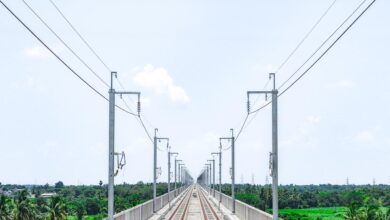
The increased investment has supported the expansion of electronic signalling, track renewal, bridge rehabilitation, rolling stock upgrades and advanced safety technologies across the railway network.
Signalling and Infrastructure Receive Major Upgrades
Indian Railways has expanded several critical safety systems aimed at reducing human error.
Safety Infrastructure Achievements
| Safety Measure | Achievement (up to June 30, 2026) |
|---|---|
| Stations with Electronic Interlocking | 6,671 |
| Stations with Complete Track Circuiting | 6,671 |
| Interlocked Level Crossing Gates | 10,395 |
Electronic Interlocking enables centralized operation of points and signals, while complete track circuiting verifies track occupancy electronically, reducing the chances of operational errors. The Railways has also strengthened protocols for signalling work, mandatory correspondence checks and system restoration procedures.
Modern Technology Driving Safer Operations
The Railways highlighted several technological initiatives that have transformed maintenance and train operations.
Technological Improvements
| Item | 2004–14 | 2014–26 | Improvement |
|---|---|---|---|
| High-quality 60 kg Rails | 57,450 km | 1.63 lakh km | 2.8 times |
| 260-metre Long Rail Panels | 9,917 km | 87,219 km | Nearly 9 times |
| Electronic Interlocking Stations | 837 | 3,691 | Over 4 times |
| Fog Safety Devices | 90 | 31,693 | 352 times |
| Thick Web Switches | Nil | 35,971 | Introduced |
These technologies reduce maintenance requirements, improve track integrity and enhance operational reliability during adverse weather conditions such as dense fog.
Better Maintenance Practices Reduce Failures
The ministry said predictive maintenance and improved inspection systems have sharply reduced weld failures and rail fractures.
Maintenance Improvements
| Parameter | Earlier | Latest | Improvement |
|---|---|---|---|
| Primary Rail Renewal | 32,260 Track Km | 57,583 Track Km | 1.78 times |
| USFD Weld Testing | 79.43 lakh | 2.25 crore | 2.8 times |
| Weld Failures | 3,699 | 272 | 93% reduction |
| Rail Fractures | 2,548 | 208 | 92% reduction |
Indian Railways now extensively uses ultrasonic flaw detection, longer welded rails, Oscillation Monitoring Systems (OMS), Track Recording Cars (TRC), mechanised maintenance and regular track patrolling to identify defects before they develop into safety risks.
Railway Infrastructure Expanded Significantly
The government also highlighted major improvements in railway infrastructure during the last decade.
Infrastructure and Rolling Stock
| Item | 2004–14 | 2014–26 | Growth |
|---|---|---|---|
| New Track Added | 14,985 km | 36,429 km | 2.5 times |
| ROBs/RUBs | 4,148 | 14,362 | More than 3 times |
| LHB Coaches Manufactured | 2,337 | 49,366 | More than 21 times |
| Unmanned Level Crossings | 8,948 | Nil | Fully Eliminated |
The Railways completed the elimination of all unmanned level crossings on Broad Gauge routes by January 2019, while replacing older ICF coaches with safer LHB coaches that offer improved crashworthiness and passenger protection.
Kavach 4.0 Expands Across High-Density Routes
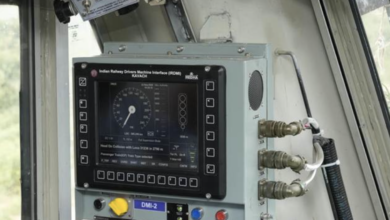
A key pillar of India’s railway safety strategy is the indigenous Kavach Automatic Train Protection System, which automatically applies brakes if the loco pilot fails to respond within prescribed speed limits.
Kavach was adopted as the national ATP system in 2020, with Version 4.0 approved in July 2024 after extensive trials and technological improvements.
As of July 13, 2026, Kavach Version 4.0 has been commissioned on 2,490 route kilometres, covering major sections of the Delhi–Mumbai and Delhi–Howrah corridors.
Kavach Commissioning
| Corridor | Route Kilometres |
|---|---|
| Delhi–Mumbai | 1,344 |
| Delhi–Howrah | 1,146 |
| Total | 2,490 |
The upgraded version offers improved location accuracy, better signal visibility in large station yards, direct integration with electronic interlocking systems and optical fibre-based communication, making it suitable for large-scale deployment across the national railway network.
Large-Scale Kavach Expansion Underway
Implementation of Kavach continues across the Indian Railways network.
Current Progress
| Component | Progress |
|---|---|
| Route Kilometres Under Implementation | 21,937 |
| Optical Fibre Cable Laid | 11,253 km |
| Telecom Towers Installed | 1,668 |
| Station Data Centres | 958 |
| Track-side Equipment Installed | 7,721 Route Km |
| Kavach-equipped Locomotives | 6,045 |
| Additional Locomotives Planned | 7,435 |
| EMU/MEMU Trains Planned | 1,200 |
The ministry also stated that more than 94,000 railway personnel, including nearly 57,000 loco pilots and assistant loco pilots, have been trained on Kavach technology. The total expenditure on Kavach up to June 2026 stands at ₹3,874.9 crore, while ₹2,066.24 crore has been allocated during 2026-27 for further expansion.
Comprehensive Safety Measures
Beyond technological upgrades, Indian Railways has implemented a wide range of operational safety initiatives, including:
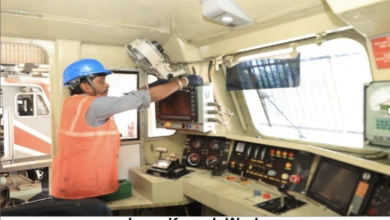
- Vigilance Control Devices (VCD) on all locomotives.
- GPS-based Fog Safety Devices for low-visibility operations.
- Mechanised track laying using advanced machines.
- Longer welded rails to minimise rail joints.
- Fire detection and suppression systems in new coaches and pantry cars.
- Elimination of all Broad Gauge unmanned level crossings.
- Regular bridge inspections and rehabilitation.
- Rolling Block maintenance planning for integrated asset renewal.
- Continuous staff training and periodic safety counselling.
The ministry added that investigations into railway accidents continue to be conducted by the Commission of Railway Safety (CRS) and departmental inquiry committees. Recommendations made after every investigation are implemented by the concerned railway administrations to address deficiencies and prevent similar incidents in the future.