President Droupadi Murmu Confers Rashtriya Vigyan Puraskar 2025 on 24 Eminent Scientists at Rashtrapati Bhavan

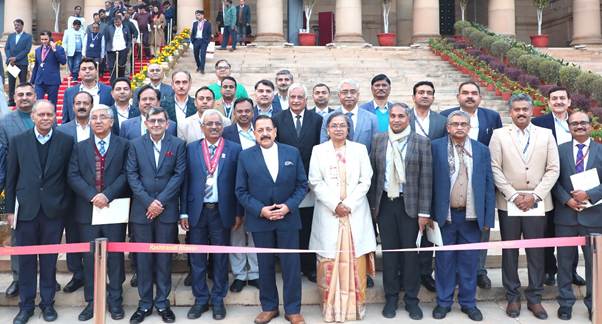
President Droupadi Murmu on Tuesday conferred the prestigious Rashtriya Vigyan Puraskar 2025 on 24 eminent scientists and innovators at a ceremonial function held at Rashtrapati Bhavan, marking a major celebration of India’s scientific excellence and innovation ecosystem. The awards were presented in the presence of Union Minister of State (Independent Charge) for Science and Technology Dr. Jitendra Singh, senior scientists, policymakers, and members of the academic community.
The highlight of this year’s ceremony was the conferment of the Rashtriya Vigyan Ratna Puraskar 2025—the highest honour under the national science awards—for lifetime achievement, awarded posthumously to renowned astrophysicist Prof. Jayant Vishnu Narlikar. Widely regarded as one of India’s most influential scientists, Prof. Narlikar made pioneering contributions to cosmology and astrophysics and played a key role in shaping scientific institutions and research culture in the country. The award recognised his lifelong dedication to science, research, and scientific temper.
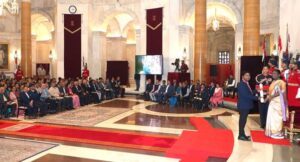
Another major recognition at the ceremony was the Rashtriya Vigyan Team Puraskar 2025, also known as the Vigyan Team Award, which was conferred on the CSIR-led Aroma Mission team. The team has been instrumental in driving India’s much-discussed “Purple Revolution” by promoting lavender cultivation and aromatic crop-based entrepreneurship, particularly in the Himalayan region. The award acknowledged the team’s success in translating scientific research into tangible socio-economic benefits at the grassroots level.
The second edition of the Rashtriya Vigyan Puraskar ceremony underscored the government’s emphasis on structured, transparent, and contemporary recognition of scientific achievement. Instituted by the Modi government, the Rashtriya Vigyan Puruskars were designed to replace older science awards with a comprehensive framework that recognises lifetime achievement, distinguished individual contributions, young scientific talent, and team-based innovation.
Addressing the gathering, President Murmu congratulated all the awardees and said that science and technology play a crucial role in shaping India’s future. She noted that the country’s progress towards becoming a developed nation depends significantly on innovation, research excellence, and the ability to apply scientific knowledge to address societal challenges.
Union Minister Dr. Jitendra Singh also congratulated the award recipients, describing them as torchbearers of India’s scientific advancement. In a post on social media platform X, he lauded the CSIR-Aroma Mission team for receiving the Rashtriya Vigyan Puraskar 2025, saying their work had “gifted the world the concept of the Purple Revolution” and opened up new avenues of agri-entrepreneurship through lavender cultivation, especially in remote and hilly terrains of the Himalayas.
The CSIR-Aroma Mission has been widely credited with empowering farmers in regions such as Jammu and Kashmir by promoting the cultivation and processing of aromatic crops. Beginning in areas like Bhaderwah and Gulmarg, lavender farming has now expanded across several parts of the Union Territory and is being adopted by other states, including Uttarakhand and Himachal Pradesh. The initiative has helped reduce India’s dependence on imported essential oils, increased farmer incomes, and demonstrated the power of coordinated, application-oriented scientific interventions.
The recognition of the Aroma Mission placed collaborative and mission-driven science at the centre of India’s national awards framework. Officials said it reflected a growing focus on science that delivers measurable outcomes, strengthens livelihoods, and addresses regional and national priorities.
Under the Vigyan Shri category, which recognises distinguished contributions in specific scientific fields, awards were conferred on several leading scientists. These included Dr. Gyanendra Pratap Singh for Agricultural Science, Dr. Yusuf Mohammad Sheikh for Atomic Energy, Dr. K. Thangaraj for Biological Sciences, Prof. Pradeep Thalappil for Chemistry, Prof. Aniruddha Bhalchandra Pandit for Engineering Sciences, Dr. S. Venkata Mohan for Environmental Science, Prof. Mahan Mj for Mathematics and Computer Science, and Shri Jayan N for Space Science and Technology. Their work was described as field-defining and impactful, contributing significantly to India’s scientific standing.
The Vigyan Yuva–Shanti Swarup Bhatnagar Award, aimed at recognising scientists below the age of 45, honoured emerging researchers for path-breaking contributions across disciplines. In Physics, Prof. Amit Kumar Agarwal and Prof. Surhud Shrikant More were recognised. Agricultural Science awardees included Dr. Jagdis Gupta Kapuganti and Dr. Satendra Kumar Mangrauthia. In Biological Sciences, Dr. Deepa Agashe and Shri Debarka Sengupta were honoured, while Dr. Dibyendu Das received the award in Chemistry.
Other recipients included Dr. Waliur Rahaman in Earth Science; Prof. Arkaprava Basu in Engineering Sciences; Prof. Sabyasachi Mukherjee and Prof. Shweta Prem Agrawal in Mathematics and Computer Science; Dr. Suresh Kumar in Medicine; Shri Ankur Garg in Space Science and Technology; and Prof. Mohanasankar Sivaprakasam in Technology and Innovation. The diversity of awardees reflected the breadth of India’s research ecosystem, spanning fundamental science, applied research, and technology-driven innovation.
Women scientists featured prominently among this year’s awardees, highlighting the growing participation and leadership of women in Indian science. Researchers such as Dr. Deepa Agashe and Prof. Shweta Prem Agrawal were recognised for their contributions, reinforcing the government’s emphasis on inclusivity and gender equity in science and technology.
Officials said the Rashtriya Vigyan Puraskar framework also aims to bring clarity and consistency to national science awards by clearly defining age limits, categories, and achievement criteria, particularly for young scientists. The presence of the President and the Science and Technology Minister at the ceremony was seen as reinforcing the national priority accorded to scientific research, innovation, and its translation into public value.
With the recognition of Prof. Jayant Narlikar’s lifelong contributions and the CSIR-Aroma Mission’s grassroots impact, the ceremony highlighted two complementary dimensions of science—deep intellectual pursuit and real-world application. As India continues to strengthen its science-led development model, the Rashtriya Vigyan Puraskar is increasingly being positioned as a platform that connects research excellence with national goals, societal needs, and sustainable development.